😃 Subscribe for Post Emails:
Oct 6:
MCS & Story Development,
Writing Process & Planning,
Chapters & Openings
Pantsers Flail, Plotters Prevail: One Column with Three Keys to Unlock Your Plot
Sep 22:
MCS & Story Development,
Writing Process & Planning
Sketch Your Next Novel Our Way; Get Started in One Day
Sep 8:
MCS & Story Development,
Writing Process & Planning,
Feedback & Retelling
Good Spiraling: Conscientiously Add Ideation and Feedback to Write Better Novels
Aug 25:
MCS & Story Development,
Writing Process & Planning
Once Upon a Time? What Fairy Tales Teach Novelists About Memory and Writing
Aug 11:
Writing Process & Planning,
Chapters & Openings
Part 3: Mastering the 100,000-Word Novel Budget: Multivalue Paragraphs
Jul 28:
Writing Process & Planning,
Chapters & Openings
Part 2: Mastering the 100,000-Word Novel Budget: Satisfying Chapters
Jul 14:
MCS & Story Development,
Writing Process & Planning,
Chapters & Openings
Part 1: How to Master the 100,000-Word Novel Budget and Make Every Word Count
Jun 30:
Feedback & Retelling,
Writer Personas,
Mindset & Motivation
Isolation's Impact: Evidence that Authors Misjudge Their Work
Jun 16:
MCS & Story Development,
Chapters & Openings,
Feedback & Retelling
Unlocking Story Sense: The Differentiator Between Good and Great Authors
Jun 2:
Contests & Anthologies,
Publishing & Career
Creation vs. Generation: Drawing a Non-technical Red Line Between Human Authorship and AI
May 19:
Marketing & Promotion,
Publishing & Career
Author Bio: From Bore to Brand with an Irresistible Tidbit in 6 Steps
May 5:
Marketing & Promotion,
Publishing & Career
Five Steps to a better Novel Cover: The A.T.E. Roadmap
Apr 21:
Marketing & Promotion,
Publishing & Career
Writers as Solepreneurs: Why Finishing your Novel Opens the Best Door to a Rewarding Business
Apr 14:
Marketing & Promotion,
Publishing & Career
How Authors Can Succeed During Economic Downturns
Apr 8:
MCS & Story Development,
Writing Process & Planning,
Publishing & Career
Have Sales Chase You: Select Writing Projects with Passion and Potential
Mar 25:
Writing Process & Planning,
Chapters & Openings,
Feedback & Retelling
The Art of Orientation: Anchoring Your Reader at Every Chapter Break
Mar 11:
Feedback & Retelling,
Writer Personas,
Mindset & Motivation
How to Cultivate "Healthy Arrogance": Part 2: The Confidence You Need to Break Through as a Novelist
Feb 25:
Feedback & Retelling,
Writer Personas,
Mindset & Motivation
How to Cultivate "Healthy Arrogance": Part 1: What Not to Do
Feb 11:
MCS & Story Development,
Writing Process & Planning,
Feedback & Retelling
Stop Writing in a Straight Line: The Power of Nonlinear Novel Development
Jan 29:
Writing Process & Planning,
Feedback & Retelling
The Waiter Problem: Why Authors Need True Product Testing
Jan 15:
MCS & Story Development,
Writing Process & Planning,
Publishing & Career
Separability Secrets: Why Subpar Prose Sells & 3 Ways that Helps Your Novels
Dec 10:
MCS & Story Development,
Characters
Create Authentic, Investable Characters: A Free Comprehensive Online Developer
Dec 3:
MCS & Story Development,
Writing Process & Planning
How to Crystallize Your Novel’s Narrative: The 4 Stages of the Minimum Complete Story
Nov 12:
MCS & Story Development,
Writing Process & Planning,
Marketing & Promotion
The 9-Sentence Novel: How to Build a Minimum Complete Story (MCS)
Nov 5:
MCS & Story Development,
Writing Process & Planning,
Feedback & Retelling
Our Minimum Complete Story (MCS): Better Novels in 90 Seconds
Oct 29:
MCS & Story Development,
Characters
Example Character: Meet Pat the Firefighter
Oct 22:
MCS & Story Development,
Characters
Character Recipe Step 2: Blend Your Equation Ingredients to Relatable Beings
Oct 16:
MCS & Story Development,
Characters
Character Equation Three: Steal Distinctiveness from Referents You Know
Oct 9:
Feedback & Retelling,
Marketing & Promotion,
Publishing & Career
Turn Readers into Superfans: Build Two-Way Connections
Oct 1:
MCS & Story Development,
Characters
Character Equation Two: Take Advantage of Readers' Cultural Knowledge
Sep 23:
MCS & Story Development,
Characters
Character Equation One: Steal Parts of Yourself For A Publishable Character
Sep 17:
Feedback & Retelling,
Publishing & Career
The Publishability Index™: A Checklist for Your Story
Sep 11:
Chapters & Openings,
Feedback & Retelling,
Contests & Anthologies
Four Musts for Compelling First Chapters
Sep 4:
Writer Personas,
Mindset & Motivation
What's Your Writer Persona? Message Morgan
Aug 28:
Writer Personas,
Mindset & Motivation,
Publishing & Career
What's Your Writer Persona? Grandiose Gary
Aug 21:
Writer Personas,
Mindset & Motivation,
Publishing & Career
What's Your Writer Persona? Publication Pat
Aug 7:
Writer Personas,
Mindset & Motivation
What's Your Writer Persona? Motivation Max
Jul 30:
Writer Personas,
Mindset & Motivation
What's Your Writer Persona? Learning Logan
Jul 9:
MCS & Story Development,
Writing Process & Planning
Bardsy's MCS: A Small Story That Makes a Big Difference
Jun 25:
Chapters & Openings,
Feedback & Retelling
How to Hook Your Readers (and Keep Them) via Commonality
Jun 11:
Mindset & Motivation,
Publishing & Career
Stories, Sweat, and Tears: 6 Tips for Writers Dealing with Rejection
Jun 4:
Feedback & Retelling,
Marketing & Promotion
Effectively Using Beta Readers in 2025
May 21:
Writing Process & Planning,
Mindset & Motivation
Have Something to Show for Your Summer
May 15:
Writing Process & Planning,
Feedback & Retelling
A Guide to Bardsy's Directed Writing Groups
Apr 24:
Writing Process & Planning,
Feedback & Retelling,
Mindset & Motivation
What Can a Writing Coach Do for You?
Feb 23:
Mindset & Motivation,
Contests & Anthologies,
Publishing & Career
Thanks, but No Thanks: When Your Writing Gets Rejected
Feb 16:
Writing Process & Planning,
Feedback & Retelling,
Contests & Anthologies
Winning Revisions: Making Writing Feedback Work for You
Feb 5:
Writing Process & Planning,
Feedback & Retelling
Collecting Writing Feedback You Can Actually Use
Jan 22:
Chapters & Openings,
Feedback & Retelling,
Contests & Anthologies
Is My First Chapter a Winner?
Jan 15:
Marketing & Promotion,
Publishing & Career
Social Media for Authors: A Marketing Mindset
Dec 30:
Marketing & Promotion,
Publishing & Career
But I Don't Want to be an Influencer . . . Social Media for Authors
Dec 18:
Writer Personas,
Mindset & Motivation,
Publishing & Career
What's Your Writer Persona? Hobbyist Hayden + Career Cary
Dec 10:
Feedback & Retelling,
Writer Personas,
Mindset & Motivation
What's Your Writer Persona? Social Sam
Jun 12:
Writing Process & Planning,
Writer Personas,
Mindset & Motivation
Planning Your Success: We're Here to Help!
Jun 5:
Feedback & Retelling,
Contests & Anthologies,
Publishing & Career
Fear Not ChatGPT: Only Humans Can Judge Writing Contests (And Stories)
Apr 23:
Feedback & Retelling,
Contests & Anthologies,
Publishing & Career
Bardsy's 2024 Anthology Contest
Apr 10:
MCS & Story Development,
Writing Process & Planning,
Feedback & Retelling
How to Prototype Your Novel and Ensure Coherence via Short Stories
Mar 19:
MCS & Story Development,
Writing Process & Planning
The Art of Memoir: Exploring the Intersection of Truth and Storytelling
Jan 17:
Mindset & Motivation,
Publishing & Career
Decisions, Decisions: Choosing a Writing Conference & Maximizing Your Time
Jan 3:
Mindset & Motivation,
Publishing & Career
Writing Conferences: A Writer’s Paradise or a Wasted Weekend?
Sep 6:
Chapters & Openings,
Feedback & Retelling,
Contests & Anthologies
What Makes a First Chapter Anthology Contest Finalist??
Jul 19:
Contests & Anthologies,
Marketing & Promotion,
Publishing & Career
Become a Published Author: What Goes Into Self-Publishing on Amazon
Jul 5:
Contests & Anthologies,
Publishing & Career
What Anthology Publication Can Do for You
Jun 28:
Feedback & Retelling,
Contests & Anthologies
How to Win Writing Contests by Passing These 3 Tests
May 10:
Contests & Anthologies,
Publishing & Career
Your Guide to Entering—and Winning—Writing Contests
May 3:
Writing Process & Planning,
Feedback & Retelling
How Great Writing Workshops Work
Mar 1:
Feedback & Retelling,
Contests & Anthologies
The Best Feedback You Will Ever Receive
Feb 15:
Writer Personas,
Mindset & Motivation
Writing Personas: Ready Riley!
Feb 6:
Marketing & Promotion,
Publishing & Career
7 Tips for Writing an Author Bio That Gets You Noticed
Jan 31:
Marketing & Promotion,
Publishing & Career
Yes, You Need an Author Website—Even If You’re Unpublished
Jun 22:
Mindset & Motivation,
Contests & Anthologies,
Publishing & Career
Small Steps to Big Success with Bardsy Anthologies
Jun 15:
Writing Process & Planning,
Mindset & Motivation
You’ll Love Writing with Will.Power
Jun 8:
Writing Process & Planning,
Feedback & Retelling,
Contests & Anthologies
Submit Early for Success
May 10:
Writing Process & Planning,
Mindset & Motivation
Determine the Next Step in Your Writing
May 4:
Writing Process & Planning,
Mindset & Motivation
Break Through Your Blocks with Will.Power
Mar 24:
Contests & Anthologies,
Publishing & Career
Avoid Instant Disqualification
Dec 14:
Feedback & Retelling,
Contests & Anthologies
Give and Ye Shall Receive
Nov 8:
MCS & Story Development,
Writing Process & Planning,
Contests & Anthologies
Turn Your Short Story Into a Novel
Takeaway
Getting started on a novel comes down to two big upfront choices: the project and its five story elements (character, world, conflict, theme and plot). Because every early choice is provisional, the stakes are low, so commit until something better comes along. Choose a project driven by passion rather than market trends, set your level of ambition, and make sure the idea gives you enough raw material. Then use the universal story template, lead with conflict rather than plot, and let coherence narrow your options. Start with whichever element excites you most, add the others, and tell the story aloud as a Minimum Complete Story (MCS). Once you can, your sketch is done and your first loop is underway.

The aim is to sketch a novel in less than a day.
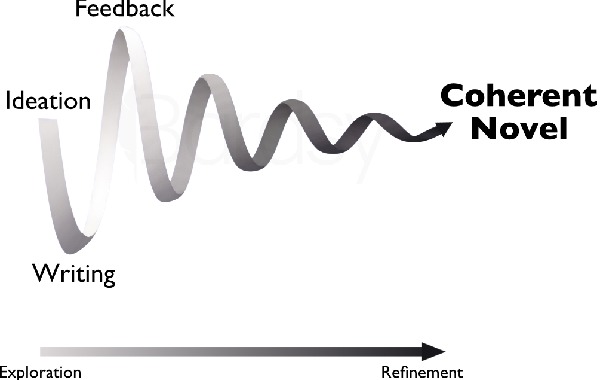
Novelists regularly ask us: What's the easiest way to start my next project? This blog post provides a good answer, which will also help you ideate your current project. Unsurprisingly to our regulars -- you are watching our YouTube videos, right? -- this answer begins with the spiral writing process we recommended last time. Recall that spiral writing repeats an ideation-writing-feedback loop, so each iteration brings you closer to a coherent novel. Let's refer to our spiral writing process graphic.
Today, we're talking about the leftmost ideation that starts your first loop. Now, look right to see your goal, a compelling novel. In that goal lies the answer as to how to start.
Put simply, your first ideation's upfront choices must drive you toward that goal. The choices that need to be made should also be clear because the goal is obvious. This insight means the process isn't easy, but it's not nearly as hard as some make it sound. Because you are at the start of a project, these choices are also the biggest, i.e. the most consequential. Yet, the stakes are almost laughably low. Why? Your first picks, like every other choice you'll make prior to publication, are provisional, meaning temporary. Think of ideating your novel, particularly early on, as a form of prototyping, thinking through the novel before committing major resources. Nothing whatsoever binds these decisions. Of course, you should commit to them until you come up with something better. We know that adopting this devil-may-care attitude, hard as it might be for perfectionists, will make your life a lot less stressful. So, don't second-guess yourself; make the two big decisions: choosing a project and its five elements (is that six decisions?) and get on with the prototyping process described below.
The aim is to sketch a novel in less than a day.
Choosing Projects
First: choosing what to write about or project selection. Over and over we've seen that projects steered by passion win out over those driven by other forces. For example: do not chase a hot genre. If you're inclined to write a romantasy, go for it. On the other hand, know that if you don't feel passionate, you will be competing against authors who are, and in a cluttered market to boot. Trends and genres come and go; what's hot this year won't be next. In other words, your passion's turn will come, and you'll have a career even if it doesn't. In addition, we suggest a pipeline of three projects: one in development (today's topic), another you're writing and a third you're actively promoting. Thus, you'll be choosing plenty of projects in your career, lowering each decision's stakes.
Passion smooths your way. For one, it makes you more likely to finish. Iterating through the ideating, writing, feedback loop takes time, eight to twelve months if you follow our approach. You will flag, wonder if it's worth it, and slam your head into the wall (lightly). Rekindling that initial passion is the best way to keep going. So, pick something you care about that makes ideation fun or, hopefully, inevitable in that you can't help thinking about that story.
Next comes setting the level of ambition: how "dense" your novel is going to be. Do you like to write heavy novels, or something lighter? Not that there's anything wrong with either. Decide for yourself how much effort you want to spend on this project. Setting this dial somewhere between something close to your heart, which you identify with, and something more peripheral will help calibrate your expectations properly. Knowing you are taking a big bite, for instance, will provide more energy down the road.
Finally, think about the availability of raw material. Specifically, how quickly do things spring to mind as you ideate the story? Better to choose an arena that provides sufficient fodder. So, the idea you choose to pursue should be the most fruitful, which correlates with passion. Better choices translate to quickly filling in and developing a story's elements (character, world, conflict, theme, and plot). If you can't elaborate these parts easily, be careful. There may not be enough material to support a project.
Story Architecture - the Elements
With a project picked, time to fill in the story. We suggest approaching this task with the universal story template (refer to the fairy tale cues blog if necessary). Recall that readers come to a novel with a set of expectations: the five elements plus a genre. Also, keep your goal -- to maximize reader satisfaction -- in mind. This leads to an observation: conflict is the most important element. Too many start with the plot and see their story as a list of events; this happens, then this happens, and so on. It is much easier to develop a story if you start with conflict and fill in the plot later. Naturally, the need to produce a coherent novel calls for choosing character, world, conflict, theme, and plot. So: who are your characters? Where does the story take place? What's the conflict? And so on. Filling in these slots, again provisionally, should not be too difficult.
In addition, accounting for coherence can actually make filling in these slots easier! Why? Because coherence limits your choices. Picture our proverbial pocket watch: every gear has to fit and do its part to serve the whole. In this way choosing some elements sets boundaries on what you choose next. For example, if your character is an alien, your genre is sci-fi. A love triangle plot, likewise, mandates some character constellations and prohibits the rest. More broadly, coherence binds the elements together so that only some combinations will work while others won't make sense. Think of it this way, if you choose four elements, the fifth almost necessarily follows.
The Payoff: A Quick Start
So to get your novel off the ground in a flash: pick one element you're drawn to. A first choice that inspires passion. Your project could begin with an engaging character, like a young magician, an expert spy or an alien to name a few. It's equally easy to build from any other element: a world you want to visit, which could be in the here and now, some other time, or one wholly imagined. You can also begin with situations, perhaps an inciting incident you want to explore or climactic confrontation you've imagined. There may be a message you want to share with the audience. And, of course, there's conflict. When you pit an irresistible force against an immovable object, a great story is almost sure to follow.
Most authors have no trouble thinking of ideas when they clear their mind and unleash their imagination. The key is to let one element rise to the surface as a place to start. From there, develop that element as far as you can in one thought. With characters, for example, work through their identity until you have something whole. Our free Comprehensive Character Developer (CCD), a worksheet that walks you through building a character, can help. As you do, you'll find you have to start adding other elements, like: here's my fictional being; now they need a world. Wherever you start, you'll eventually have to add the others until all five are there, especially conflict.
Then build out the story. At Bardsy, our Minimum Complete Story (MCS) is a prototype story, your story told aloud in about two minutes. Your prototype is complete once your telling includes all five elements. Better if it has a clear conflict and a beginning, middle and end (inciting incident, peak and resolution). The first time you say it, it may take five minutes or more; you may proceed in fits and starts as you think it through. Nevertheless, and no matter what else you do, once you have the elements in mind and can say an MCS, your prototype is done. Now, you can reflect, give yourself feedback, to see whether you want to move forward, adjust or go back to the drawing board.
We look forward to your thoughts or questions at joinus@bardsy.com.