😃 Subscribe for Post Emails:
Oct 6:
MCS & Story Development,
Writing Process & Planning,
Chapters & Openings
Pantsers Flail, Plotters Prevail: One Column with Three Keys to Unlock Your Plot
Sep 22:
MCS & Story Development,
Writing Process & Planning
Sketch Your Next Novel Our Way; Get Started in One Day
Sep 8:
MCS & Story Development,
Writing Process & Planning,
Feedback & Retelling
Good Spiraling: Conscientiously Add Ideation and Feedback to Write Better Novels
Aug 25:
MCS & Story Development,
Writing Process & Planning
Once Upon a Time? What Fairy Tales Teach Novelists About Memory and Writing
Aug 11:
Writing Process & Planning,
Chapters & Openings
Part 3: Mastering the 100,000-Word Novel Budget: Multivalue Paragraphs
Jul 28:
Writing Process & Planning,
Chapters & Openings
Part 2: Mastering the 100,000-Word Novel Budget: Satisfying Chapters
Jul 14:
MCS & Story Development,
Writing Process & Planning,
Chapters & Openings
Part 1: How to Master the 100,000-Word Novel Budget and Make Every Word Count
Jun 30:
Feedback & Retelling,
Writer Personas,
Mindset & Motivation
Isolation's Impact: Evidence that Authors Misjudge Their Work
Jun 16:
MCS & Story Development,
Chapters & Openings,
Feedback & Retelling
Unlocking Story Sense: The Differentiator Between Good and Great Authors
Jun 2:
Contests & Anthologies,
Publishing & Career
Creation vs. Generation: Drawing a Non-technical Red Line Between Human Authorship and AI
May 19:
Marketing & Promotion,
Publishing & Career
Author Bio: From Bore to Brand with an Irresistible Tidbit in 6 Steps
May 5:
Marketing & Promotion,
Publishing & Career
Five Steps to a better Novel Cover: The A.T.E. Roadmap
Apr 21:
Marketing & Promotion,
Publishing & Career
Writers as Solepreneurs: Why Finishing your Novel Opens the Best Door to a Rewarding Business
Apr 14:
Marketing & Promotion,
Publishing & Career
How Authors Can Succeed During Economic Downturns
Apr 8:
MCS & Story Development,
Writing Process & Planning,
Publishing & Career
Have Sales Chase You: Select Writing Projects with Passion and Potential
Mar 25:
Writing Process & Planning,
Chapters & Openings,
Feedback & Retelling
The Art of Orientation: Anchoring Your Reader at Every Chapter Break
Mar 11:
Feedback & Retelling,
Writer Personas,
Mindset & Motivation
How to Cultivate "Healthy Arrogance": Part 2: The Confidence You Need to Break Through as a Novelist
Feb 25:
Feedback & Retelling,
Writer Personas,
Mindset & Motivation
How to Cultivate "Healthy Arrogance": Part 1: What Not to Do
Feb 11:
MCS & Story Development,
Writing Process & Planning,
Feedback & Retelling
Stop Writing in a Straight Line: The Power of Nonlinear Novel Development
Jan 29:
Writing Process & Planning,
Feedback & Retelling
The Waiter Problem: Why Authors Need True Product Testing
Jan 15:
MCS & Story Development,
Writing Process & Planning,
Publishing & Career
Separability Secrets: Why Subpar Prose Sells & 3 Ways that Helps Your Novels
Dec 10:
MCS & Story Development,
Characters
Create Authentic, Investable Characters: A Free Comprehensive Online Developer
Dec 3:
MCS & Story Development,
Writing Process & Planning
How to Crystallize Your Novel’s Narrative: The 4 Stages of the Minimum Complete Story
Nov 12:
MCS & Story Development,
Writing Process & Planning,
Marketing & Promotion
The 9-Sentence Novel: How to Build a Minimum Complete Story (MCS)
Nov 5:
MCS & Story Development,
Writing Process & Planning,
Feedback & Retelling
Our Minimum Complete Story (MCS): Better Novels in 90 Seconds
Oct 29:
MCS & Story Development,
Characters
Example Character: Meet Pat the Firefighter
Oct 22:
MCS & Story Development,
Characters
Character Recipe Step 2: Blend Your Equation Ingredients to Relatable Beings
Oct 16:
MCS & Story Development,
Characters
Character Equation Three: Steal Distinctiveness from Referents You Know
Oct 9:
Feedback & Retelling,
Marketing & Promotion,
Publishing & Career
Turn Readers into Superfans: Build Two-Way Connections
Oct 1:
MCS & Story Development,
Characters
Character Equation Two: Take Advantage of Readers' Cultural Knowledge
Sep 23:
MCS & Story Development,
Characters
Character Equation One: Steal Parts of Yourself For A Publishable Character
Sep 17:
Feedback & Retelling,
Publishing & Career
The Publishability Index™: A Checklist for Your Story
Sep 11:
Chapters & Openings,
Feedback & Retelling,
Contests & Anthologies
Four Musts for Compelling First Chapters
Sep 4:
Writer Personas,
Mindset & Motivation
What's Your Writer Persona? Message Morgan
Aug 28:
Writer Personas,
Mindset & Motivation,
Publishing & Career
What's Your Writer Persona? Grandiose Gary
Aug 21:
Writer Personas,
Mindset & Motivation,
Publishing & Career
What's Your Writer Persona? Publication Pat
Aug 7:
Writer Personas,
Mindset & Motivation
What's Your Writer Persona? Motivation Max
Jul 30:
Writer Personas,
Mindset & Motivation
What's Your Writer Persona? Learning Logan
Jul 9:
MCS & Story Development,
Writing Process & Planning
Bardsy's MCS: A Small Story That Makes a Big Difference
Jun 25:
Chapters & Openings,
Feedback & Retelling
How to Hook Your Readers (and Keep Them) via Commonality
Jun 11:
Mindset & Motivation,
Publishing & Career
Stories, Sweat, and Tears: 6 Tips for Writers Dealing with Rejection
Jun 4:
Feedback & Retelling,
Marketing & Promotion
Effectively Using Beta Readers in 2025
May 21:
Writing Process & Planning,
Mindset & Motivation
Have Something to Show for Your Summer
May 15:
Writing Process & Planning,
Feedback & Retelling
A Guide to Bardsy's Directed Writing Groups
Apr 24:
Writing Process & Planning,
Feedback & Retelling,
Mindset & Motivation
What Can a Writing Coach Do for You?
Feb 23:
Mindset & Motivation,
Contests & Anthologies,
Publishing & Career
Thanks, but No Thanks: When Your Writing Gets Rejected
Feb 16:
Writing Process & Planning,
Feedback & Retelling,
Contests & Anthologies
Winning Revisions: Making Writing Feedback Work for You
Feb 5:
Writing Process & Planning,
Feedback & Retelling
Collecting Writing Feedback You Can Actually Use
Jan 22:
Chapters & Openings,
Feedback & Retelling,
Contests & Anthologies
Is My First Chapter a Winner?
Jan 15:
Marketing & Promotion,
Publishing & Career
Social Media for Authors: A Marketing Mindset
Dec 30:
Marketing & Promotion,
Publishing & Career
But I Don't Want to be an Influencer . . . Social Media for Authors
Dec 18:
Writer Personas,
Mindset & Motivation,
Publishing & Career
What's Your Writer Persona? Hobbyist Hayden + Career Cary
Dec 10:
Feedback & Retelling,
Writer Personas,
Mindset & Motivation
What's Your Writer Persona? Social Sam
Jun 12:
Writing Process & Planning,
Writer Personas,
Mindset & Motivation
Planning Your Success: We're Here to Help!
Jun 5:
Feedback & Retelling,
Contests & Anthologies,
Publishing & Career
Fear Not ChatGPT: Only Humans Can Judge Writing Contests (And Stories)
Apr 23:
Feedback & Retelling,
Contests & Anthologies,
Publishing & Career
Bardsy's 2024 Anthology Contest
Apr 10:
MCS & Story Development,
Writing Process & Planning,
Feedback & Retelling
How to Prototype Your Novel and Ensure Coherence via Short Stories
Mar 19:
MCS & Story Development,
Writing Process & Planning
The Art of Memoir: Exploring the Intersection of Truth and Storytelling
Jan 17:
Mindset & Motivation,
Publishing & Career
Decisions, Decisions: Choosing a Writing Conference & Maximizing Your Time
Jan 3:
Mindset & Motivation,
Publishing & Career
Writing Conferences: A Writer’s Paradise or a Wasted Weekend?
Sep 6:
Chapters & Openings,
Feedback & Retelling,
Contests & Anthologies
What Makes a First Chapter Anthology Contest Finalist??
Jul 19:
Contests & Anthologies,
Marketing & Promotion,
Publishing & Career
Become a Published Author: What Goes Into Self-Publishing on Amazon
Jul 5:
Contests & Anthologies,
Publishing & Career
What Anthology Publication Can Do for You
Jun 28:
Feedback & Retelling,
Contests & Anthologies
How to Win Writing Contests by Passing These 3 Tests
May 10:
Contests & Anthologies,
Publishing & Career
Your Guide to Entering—and Winning—Writing Contests
May 3:
Writing Process & Planning,
Feedback & Retelling
How Great Writing Workshops Work
Mar 1:
Feedback & Retelling,
Contests & Anthologies
The Best Feedback You Will Ever Receive
Feb 15:
Writer Personas,
Mindset & Motivation
Writing Personas: Ready Riley!
Feb 6:
Marketing & Promotion,
Publishing & Career
7 Tips for Writing an Author Bio That Gets You Noticed
Jan 31:
Marketing & Promotion,
Publishing & Career
Yes, You Need an Author Website—Even If You’re Unpublished
Jun 22:
Mindset & Motivation,
Contests & Anthologies,
Publishing & Career
Small Steps to Big Success with Bardsy Anthologies
Jun 15:
Writing Process & Planning,
Mindset & Motivation
You’ll Love Writing with Will.Power
Jun 8:
Writing Process & Planning,
Feedback & Retelling,
Contests & Anthologies
Submit Early for Success
May 10:
Writing Process & Planning,
Mindset & Motivation
Determine the Next Step in Your Writing
May 4:
Writing Process & Planning,
Mindset & Motivation
Break Through Your Blocks with Will.Power
Mar 24:
Contests & Anthologies,
Publishing & Career
Avoid Instant Disqualification
Dec 14:
Feedback & Retelling,
Contests & Anthologies
Give and Ye Shall Receive
Nov 8:
MCS & Story Development,
Writing Process & Planning,
Contests & Anthologies
Turn Your Short Story Into a Novel
Takeaway
Data from Bardsy's anthology contest reveals a striking disconnect between an author's confidence and the objective quality of their work, showing that the most talented writers are often paralyzed by insecurity while less experienced ones exhibit misplaced certainty. This evaluation gap stems primarily from author isolation, as solo drafting shields writers from objective feedback. To overcome this bias, authors must shift to a reader-centered perspective and utilize a structured, iterative framework—combining genre expectations, progressive tools, and organic reader "retellings"—to accurately gauge manuscript readiness and ensure their story resonates with their eventual audience.

The authors we see almost always fall into two categories: those who are almost paralyzed by insecurity and those who seem impervious to criticism, fervently believing their work is above reproach.
We regularly discuss the primary question that writers face, one that actually haunts many: Is my work ready? For some, this question shades into self-doubt: Am I good enough to write professionally? Others, oddly enough, seem entirely immune to such doubts.
The authors we see almost always fall into two categories: those who are almost paralyzed by insecurity and those who seem impervious to criticism, fervently believing their work is above reproach. Our discussions with these writers also hint at this phenomenon's cause. Put bluntly, authors, especially less experienced ones, can't seem to evaluate their own work accurately. They have particular difficulty perceiving their work as readers do.
Before talking about how to address this problem, we decided to document its existence with empirical evidence. While some creatives shy away from scientific investigation, we believe this approach can aid every author. First, the proof it offers may encourage you to follow our recommendations regarding reader empathy and testing. More broadly, whether you suffer from too much confidence or too little, this research shows there are others in the same boat.
The Problem with Confidence (or Its Absence)
Though it may be obvious, having too much or too little confidence causes problems. We've seen writers with misplaced confidence display confusion, disappointment, and frustration. Faced with rejections or poor sales, they tend to double down on their efforts even as they ignore opportunities to improve their craft. They may even give up at some point, blaming everyone but themselves when they do.
Past blog posts have discussed the roughly 2% of our anthology contest entrants who complain angrily when constructive but critical feedback challenges their ego. A larger slice, maybe 15%, displays a more tranquil arrogance, ignoring reasonable critique and moving on.
Conversely, insecurity delays and paralyzes other authors. Some refuse to share excellent work with a wider audience. Ironically, our very best authors seem to be the most insecure. Even anthology contest winners can spend years perfecting their work before feeling that it's ready to send out. Authors, as students of human nature, should find this taste of psychological research fascinating. Let's take a closer look at this phenomenon to see whether research supports our anecdotal observation that authors have trouble evaluating their own work.
A Few Words About Science and Today's Data
Some uneasiness inevitably arises when applying science to artistic endeavors like creative writing. Let's avoid knee-jerk reactions that assume science belongs exclusively alongside chemicals and lab coats. Focus, instead, on what you should trust for guidance: your personal experience, anecdotal opinions, or evidence-based lessons. Granted, that overstates the case. It's okay to find what follows slightly informative. So much the better if the evidence makes you feel more comfortable or our recommendations help your writing practice.
Science offers systematic comparisons. Professionals spend years training to make these comparisons clear and valuable. To increase clarity and value, statistics assigns numbers to these comparisons. Numbering allows us to answer two vital questions. First, we want to know whether a phenomenon is real or random. In other words, have we observed a genuine pattern or only coincidence? And, relatedly, we want to know the size of each impact. In everyday language: Does this effect matter? Knowing that a pattern is not coincidental and has a large impact suggests you should pay attention. That said, no study is perfect. Science proceeds in fits and starts, with each valid finding adding a bit of knowledge to what we know about the world.
To study authors' ability to evaluate their work, we need two sets of observations. On one side, we need an objective measure of the work's quality. If you object to using the word objective, we can also call this measure independent, an unbiased assessment of the work's quality. On the other side, we need the authors' perceptions, their judgments as to their own work's quality. Serendipitously, Bardsy's recent anthology contest offers good data for both.
Bardsy fans know that our anthology contests offer every entrant feedback as a way to encourage better writing. We'll use these editorial assessments as independent measures of each entry's quality. This feedback is built around our Publishability Index™ (PI), which tracks 23 distinct dimensions of great storytelling across seven familiar elements: character, world, conflict, theme, plot, language, and coherence. The PI, by design, meets a social scientific standard called intersubjective reliability. That technical term reflects the fact that different editors provide close to the same feedback on any story's strengths and weaknesses.
More precisely, the quality measure counts the number of major issues our editors identified. For ease of analysis, we split these observations into three categories: low, medium, and high quality, with roughly 50%, 30%, and 20% of the entries falling into each, respectively.
To pin down the hypothesized gap between reality and the authors' perceptions, we also need them to evaluate their own work. We asked a simple survey question, "Where is your work at?" to obtain these observations. The 92 respondents' answers are split into two categories, again for ease of analysis. 27% chose "My work is ready" while 73%, that is everyone else, reported their work needed various kinds of additional effort.
Results: Authors Misjudge Their Work's Readiness
When we plot author confidence against the actual number of major issues found by our editors, the data confirm our suspicions.
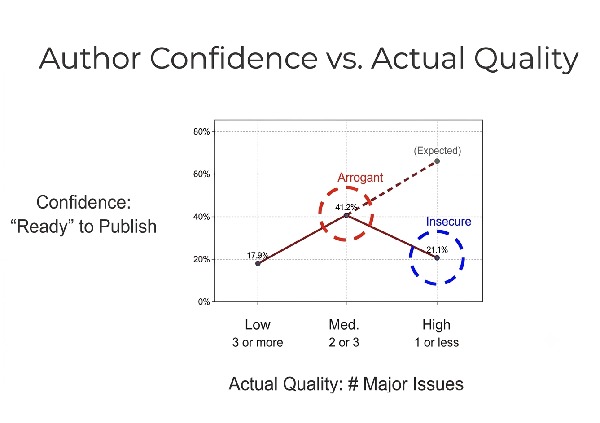
Here is the plot in tabular form:
| Actual Quality (Category) | Major Issues | Confidence ("Ready" to Publish) | Characterization |
|---|---|---|---|
| Low | 3 or more | 17.9% | — |
| Med. | 2 | 41.2% (p = .02 in a two-tailed test) | Arrogant |
| High | 1 or less | 21.1% | Insecure |
In an ideal world, one where authors judged their work accurately, we would expect a linear relationship between author confidence and actual quality. As the quality of the work (according to our editors) increases, a higher percentage of the authors would say their work was ready. You may know this as a positive correlation between the author's confidence and the work's quality. The figure's dashed line reflects this expectation.
Instead, as the figure shows, the actual data reveal an anomaly. Only 20% of the writers with high quality entries (having one or fewer issues) report their work is ready, which is nearly identical to the lowest quality group's 18%. This batch, circled in blue, demonstrates insecurity. One way to interpret this data is that 40% of these authors severely underestimate their entry's readiness to publish.
Meanwhile, we see arrogance, circled in red, in the middle category. These writers are much more likely to report their work is ready. For statistics aficionados: p = .02 in a two-tailed test for difference, which means the difference is statistically significant; more precisely, the likelihood that this result is due to coincidence is less than two times in a hundred. In plain English, this group is more likely to think their work is ready to go despite having multiple major issues.
A word of warning: It is easy to look at data and assume you're different. That interpretation may be true; some individuals, particularly in the lowest quality category, do perceive their work's quality accurately. However, the overall lesson still applies. Read on.
Misperception Comes from Author Isolation
Isolation is the most likely cause of authors' misperceptions as to their work's readiness. For most, writing a novel is a solo pursuit. We govern the process of drafting and revising alone. The relatively few times we do interact with others and try to assess our work, we often turn to people unlikely to provide accurate feedback. Our previous content has discussed the unique issues that arise from relying on friends, family, fellow authors, or paid editors. By far the best solution, then, is to have actual readers examine your work. Again, our content has detailed this reasoning and how you should obtain feedback that we call "retelling."
The broader lesson is to acknowledge your overriding goal and center your process on it. Put simply, you want to make readers happy. From this perspective, a novelist has a three-part task: first, hit your genre target; second, deliver a great story; and third, tell it effectively in around one hundred thousand words. Of course, a great deal more goes into realizing this formula; however, the task's complexity should not blind you to the fact that reader preferences drive every facet.
The greatest insight a reader-centered perspective delivers is that your attitude toward your project fundamentally differs from the way readers approach it. By the time you're done, you've spent months, if not years, producing a polished manuscript. You should know it in broad strokes and in every detail, backward, forward, and sideways. Take a random paragraph from somewhere in your book; to you, the author, it's filled with meaning. You should recall everything that has led to that passage, its context, and the import it holds for the story going forward. Now, hand that same paragraph to a new reader, a potential fan.
Even if you have written effectively, your readers can only know what you've told them up to that point. Further, they probably don't remember it very well. Novels are not textbooks that readers study for an upcoming test. Instead, they provide whatever flavor of entertainment your genre mandates to readers who have their own busy lives. Past this fact, understand that they are your customers and your eventual livelihood depends on satisfying them.
Reader Empathy: 5 Ways to Address Writing Quality Misperceptions
Author isolation obscures the inevitable gap between what you and readers bring to your novel. This chasm, more than anything else, leads to the misperceptions documented above. It also points to solutions. Building appropriate confidence, to replace insecurity or arrogance, calls for moving away from guesswork toward a reliable writing framework. Bardsy's approach includes five necessities:
- Understand genre: Identify where your passion lies, then meet that set of reader expectations.
- Develop story: Ensure you have completed all five elements, especially a plot with an inciting incident, peak and resolution; ensure the five fit together. Then, coherently layer in character arcs and a singular theme.
- Write chapters: Craft focused sections that advance the story while keeping readers engaged.
- Progressive Tools: Utilize the Minimum Complete Story (MCS), Value Triangle, and Continuity and Value Delivery Sheet (CVDS) to steadily develop and deliver a compelling novel.
- Iterative assessment: Rely on self-assessment, peer input and organic reader retellings of critical chapters to see whether your chapters allow readers to experience the story and emotionally respond as you intend.
We're happy to answer questions about this analysis if you email joinus@bardsy.com. Please share your thoughts, as well. Naturally, we're here if you'd like an unbiased evaluation of your work or if you have the symptoms mentioned in this post.