😃 Subscribe for Post Emails:
Oct 20:
Writing Process & Planning,
Mindset & Motivation,
Marketing & Promotion,
Publishing & Career
Who Chases Whom? Write a Great Manuscript So Literary Agents Pursue You
Oct 6:
MCS & Story Development,
Writing Process & Planning,
Chapters & Openings
Pantsers Flail, Plotters Prevail: One Column with Three Keys to Unlock Your Plot
Sep 22:
MCS & Story Development,
Writing Process & Planning
Sketch Your Next Novel Our Way; Get Started in One Day
Sep 8:
MCS & Story Development,
Writing Process & Planning,
Feedback & Retelling
Good Spiraling: Conscientiously Add Ideation and Feedback to Write Better Novels
Aug 25:
MCS & Story Development,
Writing Process & Planning
Once Upon a Time? What Fairy Tales Teach Novelists About Memory and Writing
Aug 11:
Writing Process & Planning,
Chapters & Openings
Part 3: Mastering the 100,000-Word Novel Budget: Multivalue Paragraphs
Jul 28:
Writing Process & Planning,
Chapters & Openings
Part 2: Mastering the 100,000-Word Novel Budget: Satisfying Chapters
Jul 14:
MCS & Story Development,
Writing Process & Planning,
Chapters & Openings
Part 1: How to Master the 100,000-Word Novel Budget and Make Every Word Count
Jun 30:
Feedback & Retelling,
Writer Personas,
Mindset & Motivation
Isolation's Impact: Evidence that Authors Misjudge Their Work
Jun 16:
MCS & Story Development,
Chapters & Openings,
Feedback & Retelling
Unlocking Story Sense: The Differentiator Between Good and Great Authors
Jun 2:
Contests & Anthologies,
Publishing & Career
Creation vs. Generation: Drawing a Non-technical Red Line Between Human Authorship and AI
May 19:
Marketing & Promotion,
Publishing & Career
Author Bio: From Bore to Brand with an Irresistible Tidbit in 6 Steps
May 5:
Marketing & Promotion,
Publishing & Career
Five Steps to a better Novel Cover: The A.T.E. Roadmap
Apr 21:
Marketing & Promotion,
Publishing & Career
Writers as Solepreneurs: Why Finishing your Novel Opens the Best Door to a Rewarding Business
Apr 14:
Marketing & Promotion,
Publishing & Career
How Authors Can Succeed During Economic Downturns
Apr 8:
MCS & Story Development,
Writing Process & Planning,
Publishing & Career
Have Sales Chase You: Select Writing Projects with Passion and Potential
Mar 25:
Writing Process & Planning,
Chapters & Openings,
Feedback & Retelling
The Art of Orientation: Anchoring Your Reader at Every Chapter Break
Mar 11:
Feedback & Retelling,
Writer Personas,
Mindset & Motivation
How to Cultivate "Healthy Arrogance": Part 2: The Confidence You Need to Break Through as a Novelist
Feb 25:
Feedback & Retelling,
Writer Personas,
Mindset & Motivation
How to Cultivate "Healthy Arrogance": Part 1: What Not to Do
Feb 11:
MCS & Story Development,
Writing Process & Planning,
Feedback & Retelling
Stop Writing in a Straight Line: The Power of Nonlinear Novel Development
Jan 29:
Writing Process & Planning,
Feedback & Retelling
The Waiter Problem: Why Authors Need True Product Testing
Jan 15:
MCS & Story Development,
Writing Process & Planning,
Publishing & Career
Separability Secrets: Why Subpar Prose Sells & 3 Ways that Helps Your Novels
Dec 10:
MCS & Story Development,
Characters
Create Authentic, Investable Characters: A Free Comprehensive Online Developer
Dec 3:
MCS & Story Development,
Writing Process & Planning
How to Crystallize Your Novel’s Narrative: The 4 Stages of the Minimum Complete Story
Nov 12:
MCS & Story Development,
Writing Process & Planning,
Marketing & Promotion
The 9-Sentence Novel: How to Build a Minimum Complete Story (MCS)
Nov 5:
MCS & Story Development,
Writing Process & Planning,
Feedback & Retelling
Our Minimum Complete Story (MCS): Better Novels in 90 Seconds
Oct 29:
MCS & Story Development,
Characters
Example Character: Meet Pat the Firefighter
Oct 22:
MCS & Story Development,
Characters
Character Recipe Step 2: Blend Your Equation Ingredients to Relatable Beings
Oct 16:
MCS & Story Development,
Characters
Character Equation Three: Steal Distinctiveness from Referents You Know
Oct 9:
Feedback & Retelling,
Marketing & Promotion,
Publishing & Career
Turn Readers into Superfans: Build Two-Way Connections
Oct 1:
MCS & Story Development,
Characters
Character Equation Two: Take Advantage of Readers' Cultural Knowledge
Sep 23:
MCS & Story Development,
Characters
Character Equation One: Steal Parts of Yourself For A Publishable Character
Sep 17:
Feedback & Retelling,
Publishing & Career
The Publishability Index™: A Checklist for Your Story
Sep 11:
Chapters & Openings,
Feedback & Retelling,
Contests & Anthologies
Four Musts for Compelling First Chapters
Sep 4:
Writer Personas,
Mindset & Motivation
What's Your Writer Persona? Message Morgan
Aug 28:
Writer Personas,
Mindset & Motivation,
Publishing & Career
What's Your Writer Persona? Grandiose Gary
Aug 21:
Writer Personas,
Mindset & Motivation,
Publishing & Career
What's Your Writer Persona? Publication Pat
Aug 7:
Writer Personas,
Mindset & Motivation
What's Your Writer Persona? Motivation Max
Jul 30:
Writer Personas,
Mindset & Motivation
What's Your Writer Persona? Learning Logan
Jul 9:
MCS & Story Development,
Writing Process & Planning
Bardsy's MCS: A Small Story That Makes a Big Difference
Jun 25:
Chapters & Openings,
Feedback & Retelling
How to Hook Your Readers (and Keep Them) via Commonality
Jun 11:
Mindset & Motivation,
Publishing & Career
Stories, Sweat, and Tears: 6 Tips for Writers Dealing with Rejection
Jun 4:
Feedback & Retelling,
Marketing & Promotion
Effectively Using Beta Readers in 2025
May 21:
Writing Process & Planning,
Mindset & Motivation
Have Something to Show for Your Summer
May 15:
Writing Process & Planning,
Feedback & Retelling
A Guide to Bardsy's Directed Writing Groups
Apr 24:
Writing Process & Planning,
Feedback & Retelling,
Mindset & Motivation
What Can a Writing Coach Do for You?
Feb 23:
Mindset & Motivation,
Contests & Anthologies,
Publishing & Career
Thanks, but No Thanks: When Your Writing Gets Rejected
Feb 16:
Writing Process & Planning,
Feedback & Retelling,
Contests & Anthologies
Winning Revisions: Making Writing Feedback Work for You
Feb 5:
Writing Process & Planning,
Feedback & Retelling
Collecting Writing Feedback You Can Actually Use
Jan 22:
Chapters & Openings,
Feedback & Retelling,
Contests & Anthologies
Is My First Chapter a Winner?
Jan 15:
Marketing & Promotion,
Publishing & Career
Social Media for Authors: A Marketing Mindset
Dec 30:
Marketing & Promotion,
Publishing & Career
But I Don't Want to be an Influencer . . . Social Media for Authors
Dec 18:
Writer Personas,
Mindset & Motivation,
Publishing & Career
What's Your Writer Persona? Hobbyist Hayden + Career Cary
Dec 10:
Feedback & Retelling,
Writer Personas,
Mindset & Motivation
What's Your Writer Persona? Social Sam
Jun 12:
Writing Process & Planning,
Writer Personas,
Mindset & Motivation
Planning Your Success: We're Here to Help!
Jun 5:
Feedback & Retelling,
Contests & Anthologies,
Publishing & Career
Fear Not ChatGPT: Only Humans Can Judge Writing Contests (And Stories)
Apr 23:
Feedback & Retelling,
Contests & Anthologies,
Publishing & Career
Bardsy's 2024 Anthology Contest
Apr 10:
MCS & Story Development,
Writing Process & Planning,
Feedback & Retelling
How to Prototype Your Novel and Ensure Coherence via Short Stories
Mar 19:
MCS & Story Development,
Writing Process & Planning
The Art of Memoir: Exploring the Intersection of Truth and Storytelling
Jan 17:
Mindset & Motivation,
Publishing & Career
Decisions, Decisions: Choosing a Writing Conference & Maximizing Your Time
Jan 3:
Mindset & Motivation,
Publishing & Career
Writing Conferences: A Writer’s Paradise or a Wasted Weekend?
Sep 6:
Chapters & Openings,
Feedback & Retelling,
Contests & Anthologies
What Makes a First Chapter Anthology Contest Finalist??
Jul 19:
Contests & Anthologies,
Marketing & Promotion,
Publishing & Career
Become a Published Author: What Goes Into Self-Publishing on Amazon
Jul 5:
Contests & Anthologies,
Publishing & Career
What Anthology Publication Can Do for You
Jun 28:
Feedback & Retelling,
Contests & Anthologies
How to Win Writing Contests by Passing These 3 Tests
May 10:
Contests & Anthologies,
Publishing & Career
Your Guide to Entering—and Winning—Writing Contests
May 3:
Writing Process & Planning,
Feedback & Retelling
How Great Writing Workshops Work
Mar 1:
Feedback & Retelling,
Contests & Anthologies
The Best Feedback You Will Ever Receive
Feb 15:
Writer Personas,
Mindset & Motivation
Writing Personas: Ready Riley!
Feb 6:
Marketing & Promotion,
Publishing & Career
7 Tips for Writing an Author Bio That Gets You Noticed
Jan 31:
Marketing & Promotion,
Publishing & Career
Yes, You Need an Author Website—Even If You’re Unpublished
Jun 22:
Mindset & Motivation,
Contests & Anthologies,
Publishing & Career
Small Steps to Big Success with Bardsy Anthologies
Jun 15:
Writing Process & Planning,
Mindset & Motivation
You’ll Love Writing with Will.Power
Jun 8:
Writing Process & Planning,
Feedback & Retelling,
Contests & Anthologies
Submit Early for Success
May 10:
Writing Process & Planning,
Mindset & Motivation
Determine the Next Step in Your Writing
May 4:
Writing Process & Planning,
Mindset & Motivation
Break Through Your Blocks with Will.Power
Mar 24:
Contests & Anthologies,
Publishing & Career
Avoid Instant Disqualification
Dec 14:
Feedback & Retelling,
Contests & Anthologies
Give and Ye Shall Receive
Nov 8:
MCS & Story Development,
Writing Process & Planning,
Contests & Anthologies
Turn Your Short Story Into a Novel
Takeaway
Your Minimum Complete Story and your novel tell the same story in different formats. The Continuity and Value Delivery Sheet (CVDS) bridges these two tools, using a single plot column and one row per chapter, roughly 30 in all. Every entry must meet three chapter keys: enough story to fill about 3,000 words; a single peak with an interim payoff that moves the throughline forward; and continuity, a sensible causal link to the chapters before and after. Plan early, revise often, and keep your MCS, CVDS, and writing in sync, and readers get a coherent novel they can follow and enjoy.

Planning, via the CVDS tool, delivers a great reading experience chapter by chapter.

This post addresses a central issue in Bardsy's approach to writing compelling novels: how do you go from your Minimum Complete Story (MCS), your story told aloud in about two minutes, to your 100,000-or-so-word novel? The answer starts with this insight: your MCS and novel tell the same story, just in different formats. This insight leads to our second most important tool, after the MCS: the Continuity and Value Delivery Sheet (CVDS). We'll talk about the why and then show you how this tool helps you plan and revise your way to a meaningful plot. To preview, you want every entry in your CVDS's plot column to fulfill the same three chapter keys your written chapters must meet: first, enough story; second, a single peak with an interim payoff that progresses the story; and third, continuity with the previous and next chapters. Then, write or revise to ensure this plot reaches your readers. We will talk about the other two CVDS columns (character and bonus) another time. Let's start by describing the problem this tool solves.
Pantsing = Bad
New authors will hear a lot about "pantsing" or "gardening," which mean roughly the same thing. Pantsing is writing without an outline, i.e., "by the seat of your pants." Gardening, a term popularized by George R.R. Martin, is equally unplanned: the story grows organically as it's written. The opposites, in case you don't know, are "plotting" and "architecting," respectively.
Let's be blunt: avoiding outlining, not to mention planning, is bad. Writing a coherent novel, one that provides the reader with a meaningful and enjoyable experience, requires planning and, later, revision. Handing readers a pantsed manuscript invites disdain, and, believe it or not, some authors expect to do just that. At best, gardening a draft leads to spending an inordinate amount of time revising, which calls for the use of tools like the CVDS. With sufficient effort, authors can turn the messiest draft into a coherent novel, but consider this a plea to do some planning in order to avoid later pain.
Coherence = Satisfaction
More bluntness: only coherent works can satisfy readers. Coherence means your five elements (character, world, conflict, theme, and plot) are fully developed and fit together throughout your novel. Absent coherence, your words are confusing and/or boring and, more importantly, can't convey meaning. It's helpful to see coherence as a goal. That goal encourages you to assess whether your writing is effective while you identify and eliminate confusion and boredom. Pursuing coherence should not be seen as a straitjacket that limits your creativity. This goal only aims to create a manuscript that readers understand well enough for it to deliver the experiences they want. In our approach, for example, you can and should jump on creative inspiration when it strikes. Incorporate any ideas that will improve your story, then use the tools to reestablish coherence as necessary.
Coherence generally flows from your brain to the reader's in three stages. First, you have to understand your story, getting it straight in your mind. When it comes to chapters, knowing your story translates to choosing a throughline (also known as the central thread or core), the combination of characters and conflict that ties a story's plot points together. Second, you put that story into words. Here, you can use today's tool, the CVDS, to provide scaffolding. Third, readers reassemble the story from the words so they can experience it. Every stage is necessary; audiences can only be satisfied if a story passes through all three successfully.
We Are Plotters
A firmly held belief in plotting (and architecting) accompanies our disdain for pantsing. Beyond the cost of revision, pantsing often strikes us as an excuse for laziness. Recall the waiter problem discussed in our courses and blogs. In fine dining, everything is choreographed for maximum enjoyment. A waiter who brings the dessert first or serves soup without a spoon fails. Likewise, we fail when readers can't experience our novels easily. It takes effort to produce a coherent masterpiece, yet readers appreciate that achievement many times more than a novel that falls short of the mark. More importantly, you can do it.
Agatha Christie provides a good model to emulate. Decades after her death, John Curran investigated her 73 "secret" notebooks, publishing a fascinating study, Agatha Christie's Secret Notebooks. Take a look at what these penciled notes, lists, and drafts, with different plots, alternate endings, and deleted scenes, reveal about her process. You can see her mind at work planning and revising. This effort helped her earn a loyal following.
Grids (Plot or Story) = Bad
Speaking of planning tools, others recognize the problem pantsing poses and have proposed solutions to make planning easier. The most common are so-called plot or story grids. These won't help you as much as they should because they are too messy. The primary issue is keeping the story coherent when laying out the chapters. Grids typically split your plot's events over too many columns, so they create cognitive overload instead of coherence. The clearest example belongs to J.K. Rowling, who famously used a grid to plot Harry Potter and the Order of the Phoenix, tracking each of the story's threads in a separate column. Take a look online to see that it is, indeed, a mess. We can't deny her success, yet her grid approach may have created more work than necessary. Why? Because authors have to reduce the multicolumn grid to a single throughline to enable coherent writing. We suggest abandoning grids in favor of a tool that concentrates every aspect of your plot into one column, which will make the issues that our three chapter keys identify excruciatingly clear.
Connecting Your MCS to Writing
A perfect plotting tool to connect your MCS and writing should be neat and narrowly focused, which means one, and only one, column devoted to plot. Our CVDS has other columns, too, because novels deliver more than plot. All these columns come from our Value Triangle, a three-part framework for deciding your novel's unique selling proposition: plot (genre), character (the reader's knowledge of them, plus their arc), and bonus (a distinctive added layer). In the same spirit, it also has one row per chapter, roughly 30 in all.
3 Chapter Keys
So, how do you plot 30 or so chapters? It's not too difficult if you remember the three keys: enough story, a single peak, and continuity. And, because all three fit into one column of the CVDS, it will be easier to lay them out, check them, and use them to guide your writing.
Key 1: Enough Story
Your MCS is your whole story and your novel is the same. In moving from the big picture, two-minute telling, to the details, the writing, you must split the story up into roughly 30 chunks. So, you're looking for the cut points. Think of an extrusion machine for pasta, sausage, or Play-Doh. Your task is to cut the relatively continuous story into chapter-sized chunks. Remember: each chunk must lead to around 3,000 words. It can be hard to make these judgments at first; however, your feel for how much plot a chapter needs will improve with experience.
The fact that a story's events are flexible assists this endeavor. You can stretch an event out over multiple chapters or shrink it to fit one. Also, if an event won't produce enough words, you can add to it until it does, merge it with something else, or drop it. It's up to you to decide how many words each event deserves. Naturally, the spiral development process (described elsewhere) implies that your choices aren't set in stone; you're allowed to shift the chapter breaks any time a better configuration appears.
Key 2: Single Peak
Each chapter should have a singular focus, just one main happening. This aligns with the chapter paradox discussed elsewhere; specifically, a chapter is a story that satisfies yet leaves the reader wanting more. Stepping back, having a single peak per chapter gives a novel roughly 30 events, which is sufficient to tell a story. Chapters without peaks are confusing because readers can't figure out what they need to remember. Chapters with two (or more) peaks are equally confusing because they divide readers' attention and each competes for a place in memory.
Remember, a chapter has to have some resolution to be a mini story; thus, each chapter's peak must have an immediate consequence. We call this first subkey an "interim payoff" because the story continues in every chapter but the last. This feature ends the chapter and leads to the next (in line with the third key). Ending on a cliffhanger, then, only works if it comes after an interim payoff. Otherwise, the chapter doesn't really end but spills over to the next. Improper chapter breaks disrespect readers. We want them to leave the reading bubble at chapter breaks, sufficiently pleased to eagerly return.
Every chapter also has to progress the story, which means moving further along the throughline. This second subkey is tantamount to relevance. Filler chapters, ones that don't tie into the central thread, are probably the biggest issue beginning authors face. Get this right, and continuity flows somewhat naturally.
Here's a useful rule of thumb: the peak plus its context, i.e., the manifestation of the throughline, should take up about 75 percent of the chapter. Use the rest for other things important to the reader's understanding, like character development outside the central thread or bonus (columns two and three of the CVDS). Put simply, central thread material should substantially outweigh all else. For example, when a "side quest" exceeds its 25 percent and starts pulling focus away from a chapter's peak, cut it down.
Key 3: Continuity
Every chapter, save the first, has a predecessor and each but the last a follower. The best way to motivate readers to continue is not adding cliffhangers but supplying strong continuity. Link your chapters together in a loosely causal chain, where each one has a peak that naturally leads to the next. The link doesn't have to be a direct A causes B, though it does have to be sensible, meaning readers can easily see the connection and follow along.
Providing "orientation" is a great way to help your readers see continuity. In the first paragraphs of each chapter, welcome the reader back and let them reenter your story. This practice is especially critical if the chapter shifts time, place, or point of view. And it's even more important in novels that don't follow a strict chronological sequence. Like "scenes from last week" in episodic television, remind the reader what's going on and reinforce the key points. Readers are casual. We are not grading them; we are trying to help them get the story.
Continuity and Value Delivery Sheet
Because it's Bardsy, we have a free interactive tool that allows you to fill in, print, and save your CVDS. Remember, it's a three-column, roughly 30-row table. To realize the three keys for each chapter, fill in each cell in the first column with the chapter's peak and just a bit of essential context. You can fill in your sheet retrospectively (looking back at drafted chapters) or prospectively (planning ahead). Sketching a few prospective rows early is fine, even encouraged.
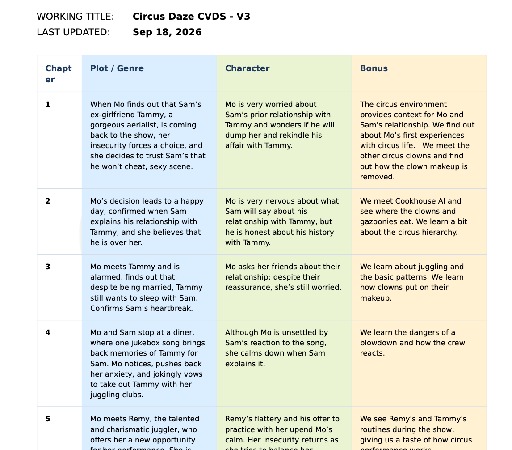
In Bardsy's view, the best time to start using the CVDS in earnest is after you've used the MCS to thoroughly explore the project and your understanding of it has stabilized. Exploration may take more or less time, depending on your expertise and prior thought; that said, you should include several draft chapters in your exploration to confirm alignment with the MCS's big picture. Having these chapters in hand will also let you fill in the top rows of your CVDS retrospectively and more concretely.
When you've completed enough rows, it's time to review. Check each chapter to see whether it has the three keys. You can call on colleagues to help you talk through these points and offer their opinions. Then, never ever forget to regularly update your sheet to match your MCS and writing. When the MCS, CVDS, and writing are in perfect synchrony, you can be almost certain you have a coherent novel.
We look forward to your thoughts or questions at joinus@bardsy.com.