😃 Subscribe for Post Emails:
Oct 6:
MCS & Story Development,
Writing Process & Planning,
Chapters & Openings
Pantsers Flail, Plotters Prevail: One Column with Three Keys to Unlock Your Plot
Sep 22:
MCS & Story Development,
Writing Process & Planning
Sketch Your Next Novel Our Way; Get Started in One Day
Sep 8:
MCS & Story Development,
Writing Process & Planning,
Feedback & Retelling
Good Spiraling: Conscientiously Add Ideation and Feedback to Write Better Novels
Aug 25:
MCS & Story Development,
Writing Process & Planning
Once Upon a Time? What Fairy Tales Teach Novelists About Memory and Writing
Aug 11:
Writing Process & Planning,
Chapters & Openings
Part 3: Mastering the 100,000-Word Novel Budget: Multivalue Paragraphs
Jul 28:
Writing Process & Planning,
Chapters & Openings
Part 2: Mastering the 100,000-Word Novel Budget: Satisfying Chapters
Jul 14:
MCS & Story Development,
Writing Process & Planning,
Chapters & Openings
Part 1: How to Master the 100,000-Word Novel Budget and Make Every Word Count
Jun 30:
Feedback & Retelling,
Writer Personas,
Mindset & Motivation
Isolation's Impact: Evidence that Authors Misjudge Their Work
Jun 16:
MCS & Story Development,
Chapters & Openings,
Feedback & Retelling
Unlocking Story Sense: The Differentiator Between Good and Great Authors
Jun 2:
Contests & Anthologies,
Publishing & Career
Creation vs. Generation: Drawing a Non-technical Red Line Between Human Authorship and AI
May 19:
Marketing & Promotion,
Publishing & Career
Author Bio: From Bore to Brand with an Irresistible Tidbit in 6 Steps
May 5:
Marketing & Promotion,
Publishing & Career
Five Steps to a better Novel Cover: The A.T.E. Roadmap
Apr 21:
Marketing & Promotion,
Publishing & Career
Writers as Solepreneurs: Why Finishing your Novel Opens the Best Door to a Rewarding Business
Apr 14:
Marketing & Promotion,
Publishing & Career
How Authors Can Succeed During Economic Downturns
Apr 8:
MCS & Story Development,
Writing Process & Planning,
Publishing & Career
Have Sales Chase You: Select Writing Projects with Passion and Potential
Mar 25:
Writing Process & Planning,
Chapters & Openings,
Feedback & Retelling
The Art of Orientation: Anchoring Your Reader at Every Chapter Break
Mar 11:
Feedback & Retelling,
Writer Personas,
Mindset & Motivation
How to Cultivate "Healthy Arrogance": Part 2: The Confidence You Need to Break Through as a Novelist
Feb 25:
Feedback & Retelling,
Writer Personas,
Mindset & Motivation
How to Cultivate "Healthy Arrogance": Part 1: What Not to Do
Feb 11:
MCS & Story Development,
Writing Process & Planning,
Feedback & Retelling
Stop Writing in a Straight Line: The Power of Nonlinear Novel Development
Jan 29:
Writing Process & Planning,
Feedback & Retelling
The Waiter Problem: Why Authors Need True Product Testing
Jan 15:
MCS & Story Development,
Writing Process & Planning,
Publishing & Career
Separability Secrets: Why Subpar Prose Sells & 3 Ways that Helps Your Novels
Dec 10:
MCS & Story Development,
Characters
Create Authentic, Investable Characters: A Free Comprehensive Online Developer
Dec 3:
MCS & Story Development,
Writing Process & Planning
How to Crystallize Your Novel’s Narrative: The 4 Stages of the Minimum Complete Story
Nov 12:
MCS & Story Development,
Writing Process & Planning,
Marketing & Promotion
The 9-Sentence Novel: How to Build a Minimum Complete Story (MCS)
Nov 5:
MCS & Story Development,
Writing Process & Planning,
Feedback & Retelling
Our Minimum Complete Story (MCS): Better Novels in 90 Seconds
Oct 29:
MCS & Story Development,
Characters
Example Character: Meet Pat the Firefighter
Oct 22:
MCS & Story Development,
Characters
Character Recipe Step 2: Blend Your Equation Ingredients to Relatable Beings
Oct 16:
MCS & Story Development,
Characters
Character Equation Three: Steal Distinctiveness from Referents You Know
Oct 9:
Feedback & Retelling,
Marketing & Promotion,
Publishing & Career
Turn Readers into Superfans: Build Two-Way Connections
Oct 1:
MCS & Story Development,
Characters
Character Equation Two: Take Advantage of Readers' Cultural Knowledge
Sep 23:
MCS & Story Development,
Characters
Character Equation One: Steal Parts of Yourself For A Publishable Character
Sep 17:
Feedback & Retelling,
Publishing & Career
The Publishability Index™: A Checklist for Your Story
Sep 11:
Chapters & Openings,
Feedback & Retelling,
Contests & Anthologies
Four Musts for Compelling First Chapters
Sep 4:
Writer Personas,
Mindset & Motivation
What's Your Writer Persona? Message Morgan
Aug 28:
Writer Personas,
Mindset & Motivation,
Publishing & Career
What's Your Writer Persona? Grandiose Gary
Aug 21:
Writer Personas,
Mindset & Motivation,
Publishing & Career
What's Your Writer Persona? Publication Pat
Aug 7:
Writer Personas,
Mindset & Motivation
What's Your Writer Persona? Motivation Max
Jul 30:
Writer Personas,
Mindset & Motivation
What's Your Writer Persona? Learning Logan
Jul 9:
MCS & Story Development,
Writing Process & Planning
Bardsy's MCS: A Small Story That Makes a Big Difference
Jun 25:
Chapters & Openings,
Feedback & Retelling
How to Hook Your Readers (and Keep Them) via Commonality
Jun 11:
Mindset & Motivation,
Publishing & Career
Stories, Sweat, and Tears: 6 Tips for Writers Dealing with Rejection
Jun 4:
Feedback & Retelling,
Marketing & Promotion
Effectively Using Beta Readers in 2025
May 21:
Writing Process & Planning,
Mindset & Motivation
Have Something to Show for Your Summer
May 15:
Writing Process & Planning,
Feedback & Retelling
A Guide to Bardsy's Directed Writing Groups
Apr 24:
Writing Process & Planning,
Feedback & Retelling,
Mindset & Motivation
What Can a Writing Coach Do for You?
Feb 23:
Mindset & Motivation,
Contests & Anthologies,
Publishing & Career
Thanks, but No Thanks: When Your Writing Gets Rejected
Feb 16:
Writing Process & Planning,
Feedback & Retelling,
Contests & Anthologies
Winning Revisions: Making Writing Feedback Work for You
Feb 5:
Writing Process & Planning,
Feedback & Retelling
Collecting Writing Feedback You Can Actually Use
Jan 22:
Chapters & Openings,
Feedback & Retelling,
Contests & Anthologies
Is My First Chapter a Winner?
Jan 15:
Marketing & Promotion,
Publishing & Career
Social Media for Authors: A Marketing Mindset
Dec 30:
Marketing & Promotion,
Publishing & Career
But I Don't Want to be an Influencer . . . Social Media for Authors
Dec 18:
Writer Personas,
Mindset & Motivation,
Publishing & Career
What's Your Writer Persona? Hobbyist Hayden + Career Cary
Dec 10:
Feedback & Retelling,
Writer Personas,
Mindset & Motivation
What's Your Writer Persona? Social Sam
Jun 12:
Writing Process & Planning,
Writer Personas,
Mindset & Motivation
Planning Your Success: We're Here to Help!
Jun 5:
Feedback & Retelling,
Contests & Anthologies,
Publishing & Career
Fear Not ChatGPT: Only Humans Can Judge Writing Contests (And Stories)
Apr 23:
Feedback & Retelling,
Contests & Anthologies,
Publishing & Career
Bardsy's 2024 Anthology Contest
Apr 10:
MCS & Story Development,
Writing Process & Planning,
Feedback & Retelling
How to Prototype Your Novel and Ensure Coherence via Short Stories
Mar 19:
MCS & Story Development,
Writing Process & Planning
The Art of Memoir: Exploring the Intersection of Truth and Storytelling
Jan 17:
Mindset & Motivation,
Publishing & Career
Decisions, Decisions: Choosing a Writing Conference & Maximizing Your Time
Jan 3:
Mindset & Motivation,
Publishing & Career
Writing Conferences: A Writer’s Paradise or a Wasted Weekend?
Sep 6:
Chapters & Openings,
Feedback & Retelling,
Contests & Anthologies
What Makes a First Chapter Anthology Contest Finalist??
Jul 19:
Contests & Anthologies,
Marketing & Promotion,
Publishing & Career
Become a Published Author: What Goes Into Self-Publishing on Amazon
Jul 5:
Contests & Anthologies,
Publishing & Career
What Anthology Publication Can Do for You
Jun 28:
Feedback & Retelling,
Contests & Anthologies
How to Win Writing Contests by Passing These 3 Tests
May 10:
Contests & Anthologies,
Publishing & Career
Your Guide to Entering—and Winning—Writing Contests
May 3:
Writing Process & Planning,
Feedback & Retelling
How Great Writing Workshops Work
Mar 1:
Feedback & Retelling,
Contests & Anthologies
The Best Feedback You Will Ever Receive
Feb 15:
Writer Personas,
Mindset & Motivation
Writing Personas: Ready Riley!
Feb 6:
Marketing & Promotion,
Publishing & Career
7 Tips for Writing an Author Bio That Gets You Noticed
Jan 31:
Marketing & Promotion,
Publishing & Career
Yes, You Need an Author Website—Even If You’re Unpublished
Jun 22:
Mindset & Motivation,
Contests & Anthologies,
Publishing & Career
Small Steps to Big Success with Bardsy Anthologies
Jun 15:
Writing Process & Planning,
Mindset & Motivation
You’ll Love Writing with Will.Power
Jun 8:
Writing Process & Planning,
Feedback & Retelling,
Contests & Anthologies
Submit Early for Success
May 10:
Writing Process & Planning,
Mindset & Motivation
Determine the Next Step in Your Writing
May 4:
Writing Process & Planning,
Mindset & Motivation
Break Through Your Blocks with Will.Power
Mar 24:
Contests & Anthologies,
Publishing & Career
Avoid Instant Disqualification
Dec 14:
Feedback & Retelling,
Contests & Anthologies
Give and Ye Shall Receive
Nov 8:
MCS & Story Development,
Writing Process & Planning,
Contests & Anthologies
Turn Your Short Story Into a Novel


All the MCS benefits come from using your voice. Thinking about your story, without saying it aloud, does much, much less.
Bardsy's Minimum Complete Story (MCS) is simply your novel's story, told aloud in about 90 seconds. Constructed properly, it distills a novel to its essentials, a 10,000-foot overview that orients and checks your writing. Though it appears easy to do, saying your MCS out loud is harder than it seems. More importantly, mistakenly seeing it as easy makes authors skip the hard work it requires. To be clear: all the MCS benefits listed in last week's post Better Novels in 90 Seconds come from using your voice. Thinking about your story, without saying it aloud, does much, much less to advance your work. Further, the more you tell it, the more it does for you.
Now that you know its value, this week's post covers creating your first MCS. It offers a companion worksheet that you should download and have available as you read this post; we'll use it to get your first MCS rolling. Before you ask, an MCS can be created at any time in the writing process from prior to writing a word until you've finished a draft. Alternatively, you can put it off to the last minute and use it to help query agents and publishers. That said, the sooner you start, the better. More forethought makes for more efficient writing, especially insofar as this tool emphasizes coherence. Don't be concerned about starting too early, either. The MCS's flexibility means it can accommodate change. And, as always, we hope this blog will entice you into signing up for our MCS workshop this Saturday, where you can learn more and possiblty practice yours.
MCS Benefits
Let's summarize the benefits described in part one:
First, your MCS sets goalposts for your writing by pinning down the characters, world, conflict, theme and plot as well as where the story begins, peaks and ends. Having this target keeps your writing aligned with the overall narrative, ensuring coherence and, thus, reader satisfaction.
Second, each telling also assesses how well your story's essential components contribute to the narrative and synergy, highlighting areas that require further development. Meanwhile, regular tellings automatically develop your story subconsciously.
Third, this technique encourages exploration, allowing you to compare high level alternatives and choose the best for your novel. In this vein, it helps gauge the relevance and impact of any detail, large or small.
Fourth, saying it out loud every time you start writing puts you in the right frame of mind by recalling the story into your active memory. This orients your words and helps overcome writer's block.
Fifth, an added bonus, it supports your querying and marketing efforts. So, there are five big benefits in all, plus a bonus, enough to make this the best way to spend 90 seconds on your story.
Seems like a lot!!!
Use the PreMCS Worksheet to Create Your MCS
Hopefully, you're eager to get started, so grab that free Pre-MCS worksheet. As you can see the sheet follows from Bardsy's definition of story, the coherent combination of character, world, conflict, theme and plot. These five elements stack along the left. The character and plot elements have extra rows to provide room for more detail, specifically, it sets aside space for three characters: main, villain and a potential third while plot includes the inciting incident, peak and end. The sheet has nine spaces in all.
Enter one (and only one) sentence for each element
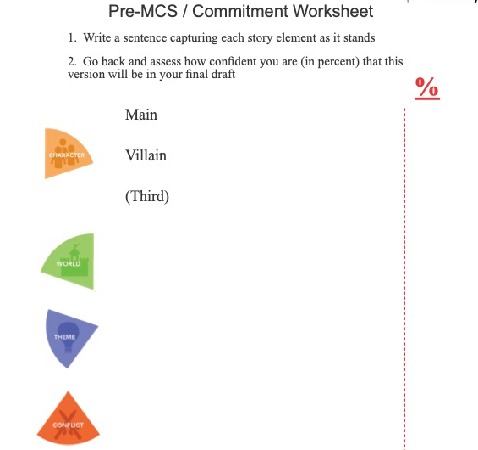
Moving downward from the sheet's top, enter a sentence describing each element. It's ok if you haven't given much thought to an element, put down what you have. It's also ok to leave a row blank or enter TBD. Novels never spring like Athena fully-formed from an author's brain. Instead, they come in bits and pieces, gradually growing and coalescing into a whole. To think any other way holds you to an impossible standard that prevents forward motion. Do your best and pat yourself on the back for what you do have; even one element will get you going.
Do your best to describe each element succinctly to ignite the distillation process. You want about one medium-length sentence for each element. Suppress the urge to write more. Remember the entire MCS must fit into your active memory for it to do its magic. This magic depends on separating your story's essentials from less important aspects. For example, you could write a few paragraphs on your world. Don't! Try to figure out exactly what facets of your setting are critical to the story. It could be the historical era, the geography or the presence of magic; however, it can't be too much. Pick the one or two features that stand out to make your sentence. At the same time, don't strain to come up with something. Usually what comes to mind immediately accurately captures that element, or at least your current thinking. Beyond that, keep in mind that your novel is a work in progress, meaning you can and will modify or replace these sentences as your story develops.
Extra Credit: Assess Your (Percentage) Confidence In Each
When you're done with the elements, jot down a number that expresses your confidence in how well what you've written describes how that element will appear in your published novel. So, if you're perfectly certain that a main character won't change from this point, a 100 it is. Blank spaces are easy, too; they get a zero. Be honest with yourself, self-deception serves no purpose. Likewise, be careful to avoid over commitment, far better to put a 90 than to express false confidence and prematurely lock yourself in. Your novel remains a work in progress until the publisher, self or trad, accepts it. This fact gives you the freedom to accurately portray its present state and welcome improvement. To jump ahead, imagine Shakespeare being committed to a more evil Romeo, trying to hook up with Juliet for giggles. Only after thought (and maybe MCS-like rehearsals) would he break that commitment in favor of a new and improved story.
To repeat, we want and indeed expect the story to change as you write. So, the confidence numbers only indicate what is more (or less) set as opposed to being an ironclad contract. This allows your MCS to revolve around the more established, closer to a hundred, elements. Being a hundred percent certain about an inciting incident suggests that you should start your story with that element and begin from there. Similarly, you can also start with a hundred percent theme when you know the message you want to share but not exactly how to get it across. The idea is to let these more stable pieces drive your MCS, so you can focus on the rest.
Your First Attempt
Your completed sheet should have roughly nine sentences. Now, let your brain transform these essentials into a story by telling them aloud. Crucially, these are notes to speak from, not a script. You can hold it in your hand as you tell it as a kind of security blanket but do not read it unless you absolutely must. Reading tends to lock an element in place, preventing the flexibility progress demands. Worse, reading also encourages line editing, coming up with the perfect way to describe an element. That approach contradicts our goal by draining the life from your MCS. Please resist temptation. Try to perfect the oral telling and revise the sheet to follow; put another way, the telling should lead future versions of the sheet, not the other way round. In all honesty, the sheet is a crutch to get you going; abandon it as soon as possible.

Start with the world and characters, adding the inciting incident, peak, and resolution, the conflict and theme should be crystal clear. Don't stress!
In your first telling, start with the world and central characters, adding the inciting incident, peak, and resolution. When you're done, the conflict and theme should be crystal clear to your listeners. Don't stress! Keep in mind that your MCS should and will change; usually it's incomplete until you've written a few chapters, and it may not be crystallized until you've finished your first draft. Telling your entire MCS aloud from memory (that's key) should take a minute or two. Your first MCS tellings usually go way over the time limit. Sometimes as long as five minutes! Again, it's ok; it reflects your brain's urge to add detail. Future versions will hone in on the essentials, condensing as necessary and weeding out irrelevance. Only when you're comfortable, use a timer. It also helps to make a recording and find a live listener. We'll discuss these techniques and how they accelerate your MCS next time.
Notice an MCS isn't a chronology or list of events; it doesn't tease, like flap copy, nor does it include any editorial comments. It also doesn't hide anything, so no surprises. Always remember: your MCS is a stand-alone story, your narrative in its least possible form.
Use fairy-tale cues if you're stuck: Once upon a time, unbeknownst to them, then one day, etc. Generations of humans have used these for exactly this purpose. For practice, build an MCS for your favorite movie or novel, stripping it to the essentials while leaving the narrative intact. You'll see how easily you can build a favorite's MCS to quickly retell the story. Despite the years that have passed since you last thought about them, coherence allows you to effortlessly access and quickly tell your favorite stories. Here's one of our favorite samples:
Once upon a time, in Renaissance Italy, headstrong teen Romeo falls hopelessly in love with Juliet. Unbeknownst at the time, their families are rivals, indeed sworn enemies. As romance unfolds, friends and cousins attempt to extinguish their love, even murdering one another. The lovers tire of this conflict but become desperate, so they commit to their love and craft a plan. Mistakes, however, lead both to kill themselves. The families mourn and vow to be better.
Granted, it's a relatively short play, but these few sentences are enough to tell the story.
As you know, your MCS adjusts every time it's told. Through repeated tellings, it will automatically become more coherent as you come to understand and finish developing your story. You will add, delete or rearrange parts, sometimes beneath your awareness. Better yet, saying the MCS also helps integrate its parts into a unified, captivating whole. We'll pick up this thought next time.
A final plug: please come to our 11/15 workshop to learn more and possibly practice your MCS under our guiding yet supportive eye. There is something about seeing others do it that multiplies the benefits of this exercise. It really is the best way to spend 90 seconds to improve your story. If you can't make it let us know, so we can discuss other ways to make progress.